ع
ع



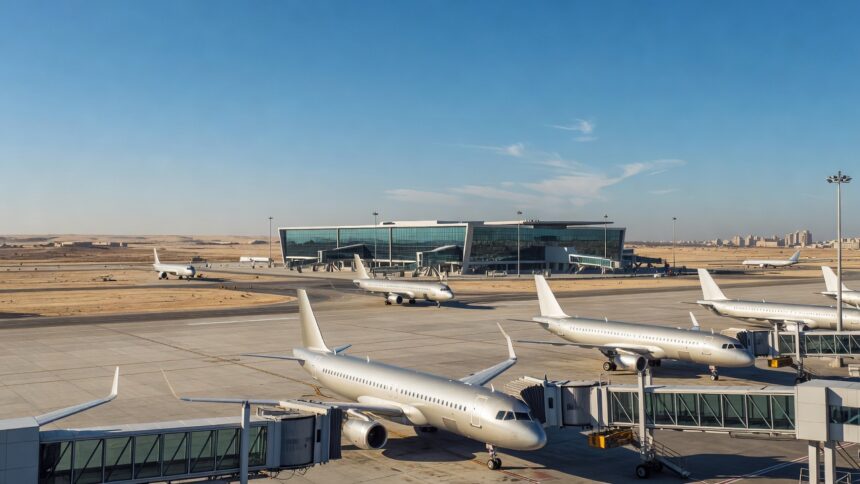


Embraer’s Market Outlook 2026 stated that Turkiye and Saudi Arabia have shown more resilience than other Middle East markets to the aviation disruptions triggered by the US-Israel-Iran conflict, thanks to their sizeable domestic travel and point-to-point demand. Turkiye’s distance from the conflict zone enabled its carriers to capture diverted transfer traffic that might otherwise have routed through Gulf hubs, while Saudi Arabia drew on a combination of local journeys and religious tourism to sustain passenger numbers. The report tracked year-on-year departure changes for Qatar, Saudi Arabia, Turkiye and the UAE in early 2026, revealing steadier results for Turkiye and Saudi Arabia that sometimes turned positive while others saw sharper volatility.
This performance contrasted with transfer-reliant Gulf carriers that depend primarily on long-haul connections and proved more exposed to geopolitical shocks, according to the Embraer document. “The stronger the local and regional traffic base, the better airlines can withstand geopolitical shocks,” the report stated. The Brazilian manufacturer’s analysis forms part of a broader executive summary that anticipates a global shift toward mixed aircraft fleets pairing smaller new-generation narrowbodies with larger types to gain efficiency and flexibility.
Embraer projected 8,500 new jet deliveries worldwide across regions that include North America, Latin America, Europe and the CIS, Africa, the Middle East, China and Asia Pacific. IATA forecasts place 2026 net profit for Middle East airlines at $6.9 billion with the regional passenger total reaching 240 million at a 6.1 percent growth rate, exceeding the global average of 4.9 percent, even as later IATA assessments flagged an 11.4 percent contraction in revenue passenger kilometers for the region due to airspace restrictions. “The efficiency of new-generation small narrowbodies will drive a trend to more mixed-aircraft fleets,” the Embraer report stated.
The number of Middle East city pairs with nonstop service has remained roughly flat over the past decade, fluctuating between 495 and 615 rather than expanding alongside added capacity, Embraer’s Market Outlook 2026 reported. Low-cost carriers have gained market share from full-service airlines, directing around 50 percent of their seat capacity to intra-regional and domestic routes compared with 36 percent for full-service operators. OAG figures for July 2026 put total Middle East seat capacity at 36.3 million, down 6.1 percent from a year earlier, with low-cost carriers accounting for 28 percent of the market.
Government programmes throughout the region continue to view aviation as integral to economic diversification, sustaining investment in airports, tourism infrastructure and network development that supports trade, tourism and growth, the report found. The conflict has raised operating costs, compressed margins and reduced passenger confidence, yet the region’s long-term potential remains intact within a more volatile operating environment, Embraer stated. “Investment in airports, tourism infrastructure, and network development remains substantial and reaffirms the structural role of aviation in enabling trade, tourism, and broader economic growth,” the document added.
Embraer President and CEO Arjan Meijer described global aviation as moving from a centralised network toward “a more distributed, multipolar reality” in his message attached to the outlook. He argued that airlines require mixed-fleet strategies to match capacity to evolving travel patterns, with smaller efficient jets offering the agility to serve thinner routes, increase frequency and open markets that larger aircraft cannot economically sustain. Mordor Intelligence data places the Middle East aviation market at $30.07 billion in 2026, advancing from $28.64 billion the previous year on a projected 4.75 percent compound annual growth rate through 2031.