ع
ع






Elm’s work with SAL and Madar, followed by its investment in Sirdab, shows how digital coordination is becoming a strategic layer alongside Saudi Arabia’s physical logistics buildout.
Saudi Arabia’s logistics transformation is usually measured in ports, roads, warehouses and distribution centres. A second buildout is now becoming visible above those assets: the software that schedules shipments, connects capacity, tracks inventory, automates transactions and gives operators a common view of infrastructure spread across multiple owners and locations.
Few companies illustrate that convergence more clearly than Elm. In August 2025, the Saudi digital-solutions company signed an agreement with SAL Logistics Services to build an integrated platform covering shipment scheduling, payment management, delivery notifications and appointment booking across SAL’s airport stations. Elm described the project as part of a broader move toward faster, more transparent logistics operations.
Four months later, Elm increased its stake in Sahl Almadar Trading Company, owner of the Madar digital platform connecting shippers and carriers through tracking, automation, government-service integration, a digital marketplace and payments. Elm’s 2025 annual report also records its work on Port Community Systems, logistics dashboards at major ports and King Fahd Causeway, and a truck-management system with Saudi Arabia Railways.
Capital follows the operating layer
The third move came on 3 September 2026, when Elm and BECO Capital co-led Sirdab’s $10 million Series A, alongside Y Combinator, COTU Ventures and D Global Ventures.
Sirdab operates in the layer between logistics real estate and daily execution. Companies can use its platform to access verified warehousing and transportation, manage inventory and orders across locations and monitor service levels, while providers use the same infrastructure to share capacity and manage operations, billing and compliance. The company says its network now extends across more than 120 warehouses and 60 transportation providers, serving more than 850 businesses.
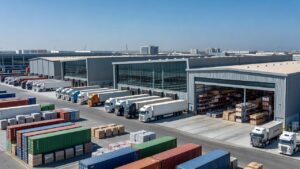
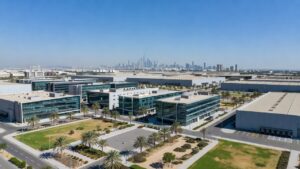
The pattern matters because software becomes more valuable as physical infrastructure becomes larger and more distributed. Saudi Arabia’s national logistics masterplan covers 59 centres exceeding 100 million square metres. A network of that scale creates an equally large opportunity for platforms that can make capacity searchable, operations visible and service levels measurable across separate facilities and providers.
From infrastructure to intelligence
Sirdab co-founder Abdulrahman Alnamlah set out that thesis in a company article published on 30 July 2025, arguing that the next phase of logistics leadership would be increasingly defined by execution, automation and visibility rather than infrastructure alone. The company describes its own role as integrating warehousing, transportation and service-level tracking so that businesses can see and coordinate operations through one system. His article framed the shift as one “from infrastructure to intelligence.”
One distinction keeps the investment thesis precise. Elm’s participation in Sirdab’s Series A is a disclosed investment, while Elm’s work with SAL and Madar involves separate commercial and investment relationships. Their significance lies in the common direction across those moves: deeper digitisation of logistics coordination.
Sirdab’s next development phase fits directly into that theme. The company says its Series A will fund expansion in Saudi Arabia and the GCC, growth of its provider network and further platform development, including AI designed to match companies with suitable capacity and automate day-to-day coordination between warehouses, shippers and carriers.
One platform, hundreds of physical assets
The strategic value of that software becomes clearer when logistics extends beyond cartons and pallets. In November 2025, Sirdab said it supported Saudi Investment Recycling Company in deploying and managing more than 500 smart plastic-recycling machines across the Kingdom. Its platform assigned units unique identifiers and tracked their location and deployment status while coordinating storage and dispatch across a nationwide network. The company’s published case study presents the project as an example of combining physical distribution with real-time asset visibility.
That is the larger Saudi opportunity. The Kingdom has already committed to building the physical nodes of a global logistics hub. The next value pool sits in making those nodes operate as an integrated system. Elm’s sequence of logistics investments and partnerships suggests strategic capital is moving toward that layer, while Sirdab’s new funding gives a Saudi-founded company more resources to build inside it.
Saudi logistics is no longer only an infrastructure story. Increasingly, it is also a software story, and the companies capable of connecting warehouses, transport, data and execution are becoming part of the infrastructure themselves.