ع
ع



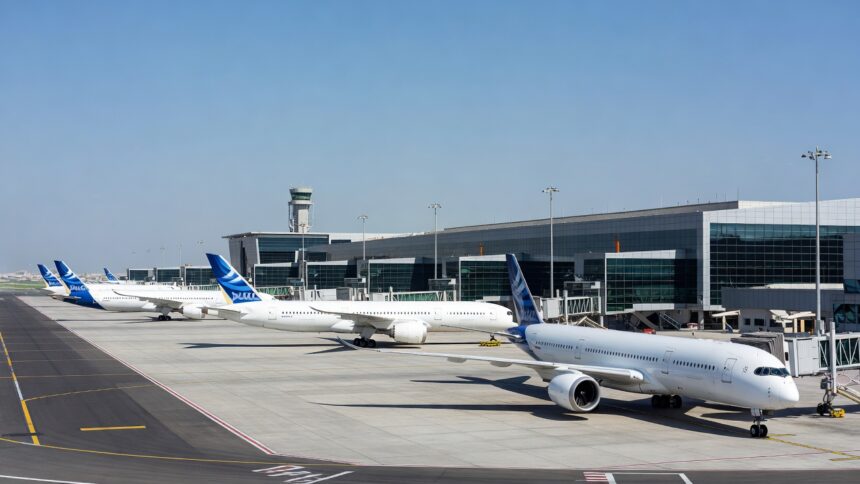


Emirates President Tim Clark said the airline continues to operate effectively despite challenges posed by regional tensions as he spoke on the sidelines of the Farnborough International Airshow. “As long as the situation, as bad as it is at the moment, is manageable, we can still continue what we’re doing,” Clark told Reuters. He added that the carrier has no plans to defer orders while its premium cabins remain full. Clark further noted that the sector must “think positive, act positive, be positive” when projecting recovery according to his interview with the news agency.
Dubai Airports CEO Paul Griffiths observed that conditions appear more normal when viewed from the centre of Gulf operations in remarks carried by Reuters on the same day. “I think the closer you are to the centre of the Gulf operation, the more normal you realise things are,” Griffiths said. He confirmed that the new Dubai airport project remains on its targeted opening schedule in line with parallel statements from Clark about a separate UAE airport slated for 2032.
The executives’ comments followed continued US strikes on Iran for a 10th consecutive night along with Iranian attacks on US sites in Bahrain, Kuwait and Jordan which shattered a fragile interim peace accord signed the previous month, Reuters reported. Middle Eastern carriers experienced traffic declines after the Israel-US war on Iran began on February 28 with some implementing capacity cuts to offset rising costs. IATA data from May 2026 showed a 46.6 percent year-on-year drop in passenger demand for carriers in the region during April.
An industry assessment published in June detailed a strong rebound in aviation activity across major Gulf hubs in the ensuing months. The report placed daily flights in Dubai at 844 in June compared with 499 in March while Abu Dhabi rose from 174 to 462 and Doha increased from 42 to 570 over the same period. Traffic has steadily recovered in recent weeks for many of the region’s core carriers according to the aviation leaders who addressed the situation at Farnborough.
IATA’s latest financial outlook projected a collective 4.3 billion dollar loss for Middle East airlines in 2026 with passenger demand forecast to decline 11.4 percent and net margins turning negative to minus 6.1 percent. The global organisation separately forecast worldwide passenger numbers to reach 5.1 billion in 2026 representing a 2.4 percent increase on the prior year. Clark’s assurances of operational continuity and unchanged fleet plans come against this mixed regional picture.
The Farnborough International Airshow opened with announcements involving Boeing and Airbus orders in addition to discussions on air defence systems according to coverage of the event. An IBA forecast anticipated up to 875 aircraft orders across the show reflecting sustained commercial interest in the sector. Executives used the platform to emphasise that the Middle East’s aviation business remains open while adapting to the current environment.