ع
ع





India’s aviation turbine fuel consumption is projected to expand at an annual rate of 7.7 percent and rise fivefold by 2047 to reach 62 million tonnes by 2050, leaving carriers increasingly exposed to international price shocks given that the country imports nearly 90 percent of its crude oil, according to a June 2026 analysis by the India Energy and Climate Center at the UC Berkeley Goldman School of Public Policy and Energy Innovation. The study, titled India’s Aviation Opportunity, warned that without shifts toward domestic production the growth would heighten vulnerability to supply disruptions and undermine energy self-reliance goals. Global jet fuel demand could climb to 18 million barrels per day by 2050 as population and travel volumes increase, Thunder Said Energy data indicate, amplifying pressure on conventional supplies worldwide.
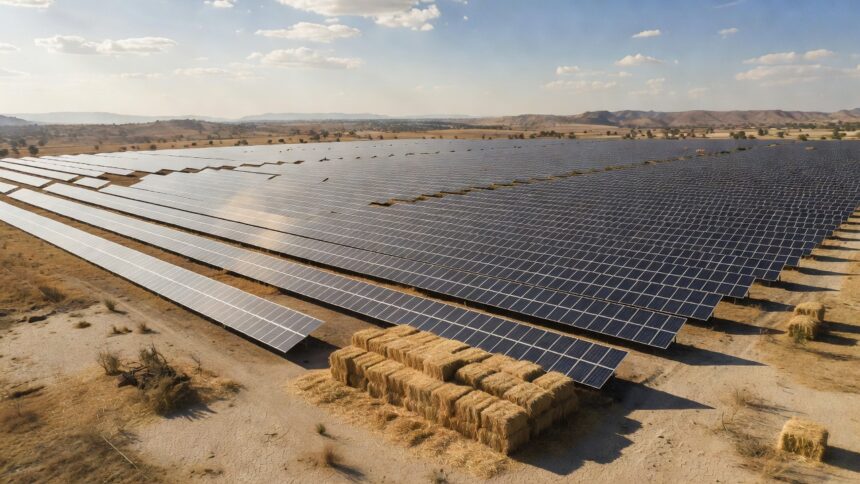
Power-and-biomass-to-liquids technology that combines surplus agricultural residue with low-cost solar-generated green hydrogen offers the capacity to yield between 37 million and 67 million tonnes of sustainable aviation fuel annually, the report found, a range sufficient to cover all projected domestic needs by mid-century. Researchers calculated that meeting the 2050 target would require only about 1,000 gigawatts of solar capacity occupying roughly 0.4 percent of India’s land, none of it fertile, in contrast to crop-based pathways that could demand 6 percent to 7 percent of arable farmland. The India Energy and Climate Center assessment placed baseline production costs for this synthetic route at $1.41 per litre when green hydrogen is secured at $3 per kilogram, a figure already achieved in recent Indian auctions.
Those costs sit 30 percent to 40 percent below prevailing global sustainable aviation fuel benchmarks that range from $1.60 to $2.40 per litre and are only one-fifth the expense of European e-fuel alternatives priced near $7.20 per litre, according to the collaborative study involving UC Berkeley and Energy Innovation. The analysis determined that synthetic fuel from this pathway would achieve cost parity with fossil jet fuel in the 2030s under various oil-price scenarios, with projects commissioned by 2036 reaching levelized equivalence over a 25-year lifespan. India Energy and Climate Center researchers noted in the report that the approach delivers the deepest greenhouse-gas reductions among major pathways, exceeding 95 percent, while using biomass and electricity far more efficiently than alternatives.
Regulatory mandates in Europe create immediate export opportunities for the Indian product before full domestic cost parity is reached, the report stated, as the European Union’s ReFuelEU framework requires fuel suppliers to blend 2 percent sustainable aviation fuel starting in 2025 and raise that share to 70 percent by 2050 while excluding biofuels derived from food or feed crops. The United Kingdom maintains a parallel trajectory to 22 percent by 2040 with similar exclusions, directing demand toward synthetic and residue-based options that the power-and-biomass-to-liquids route satisfies. International Air Transport Association forecasts call for 360 million tonnes of sustainable aviation fuel globally by 2050 to support industry decarbonisation, yet current supply stands at only about 2.4 million tonnes this year, leaving premium markets open for early producers.
Geopolitical events earlier this year illustrated the hedging value of domestic synthetic capacity when closures in the Strait of Hormuz drove average crude prices to $197 per barrel and jet crack spreads to $86 per barrel during one week in March, pushing delivered Indian jet fuel costs on international routes to $2.39 per litre. That price was 70 percent higher than the projected 2030 production cost for the synthetic alternative, the India Energy and Climate Center and Energy Innovation study calculated, demonstrating how local supply buffers against volatility. The authors added that establishing production facilities now would allow producers to capture European premium revenues while constructing a strategic reserve for domestic carriers.
Beyond energy security the technology addresses agricultural residue burning that contributes to 44,000 to 98,000 premature deaths annually across India by creating value for 130 million tonnes of material currently set alight each year out of a 210-million to 235-million-tonne surplus, according to the report’s assessment. Spatial mapping showed optimal locations near major airports in the Delhi, Mumbai and Pune regions where residue supply chains and solar resources converge. The analysis emphasised that policy support for initial demonstration projects anchored by public-sector undertakings could accelerate deployment and unlock rural employment while advancing national net-zero objectives set for 2070.
The report’s authors concluded that prioritising this pathway over less efficient alternatives would position India as a low-cost global hub for sustainable aviation fuel, potentially generating a multibillion-dollar export industry while cutting reliance on imported fossil inputs. Early investment, they wrote, enables the sector to capitalise on long-term cost reductions as scale increases and technology matures. Data from the study further indicated that the synthetic fuel carries lower monetary risk than fossil equivalents because costs are largely rupee-denominated and insulated from dollar inflation and currency depreciation trends observed over recent decades.