ع
ع



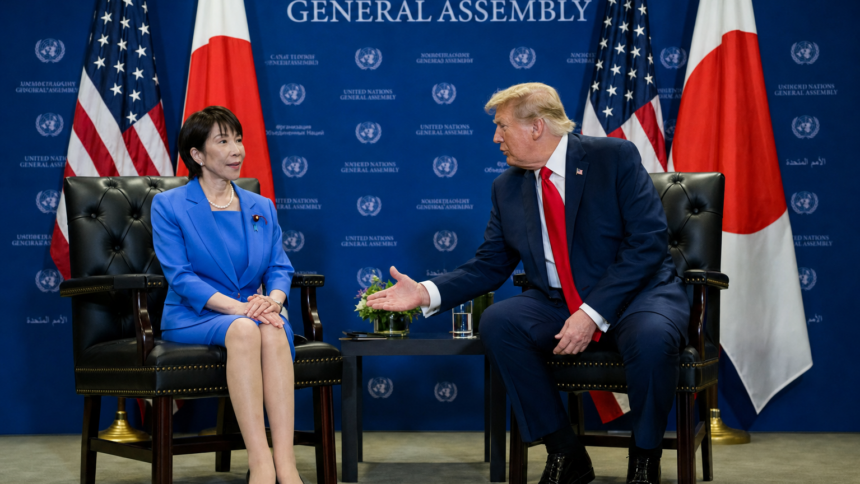


Japan’s Finance Minister Satsuki Katayama offered an unusually detailed readout of a private leaders’ discussion at a regular news conference in Tokyo. Katayama stated that Trump raised the issue of yen weakness and its effect on American trade during the bilateral meeting. In reply, Prime Minister Sanae Takaichi noted that an undervalued yen is problematic in general terms, according to the minister, who said she released the account only after checking with the Prime Minister’s Office.
The summit between Trump and Takaichi took place on Sept. 22 on the sidelines of the UN General Assembly in New York. Such public remarks on currency levels by the two countries’ leaders remain rare because governments typically keep those conversations confidential. Katayama stressed that the exchange did not extend to any discussion of Japanese monetary or fiscal measures and that the administration’s economic approach is unchanged.
The comments reflect continued focus in both capitals on the yen’s path after Japanese and US authorities conducted a joint intervention on July 31 to counter excessive moves in the currency. The yen had earlier reached levels near 164 to the dollar, its weakest in more than 39 years, a development reported across Japanese outlets including The Mainichi. Katayama added that the leaders’ remarks reaffirmed the joint stance that underpinned that July action.
A sustained gap in interest rates between Japan and the United States has remained a primary driver of yen weakness, according to assessments from Japanese financial authorities. Concerns over the trajectory of Japanese government bond yields and their potential spillover to US markets have also figured in bilateral talks. US Treasury Secretary Scott Bessent and Katayama held a separate call to reaffirm their shared view on the desirability of a stronger yen that reflects Japan’s economic fundamentals.
Trump has frequently linked currency values to trade imbalances, arguing that a weaker yen disadvantages US manufacturers. The weak yen supports Japanese exporters through more competitive pricing overseas yet increases costs for energy and raw material imports into Japan. Katayama said the US side specifically cited trade difficulties stemming from the yen’s level during the summit conversation.
The finance minister said she and Bessent would maintain close coordination on foreign exchange issues and related topics going forward. Market participants noted a modest yen gain to around 158.30 against the dollar in the hours after Katayama’s briefing, according to data compiled by Bloomberg. Japanese officials continue to monitor currency moves for signs of disorderly volatility that could prompt further action.