ع
ع



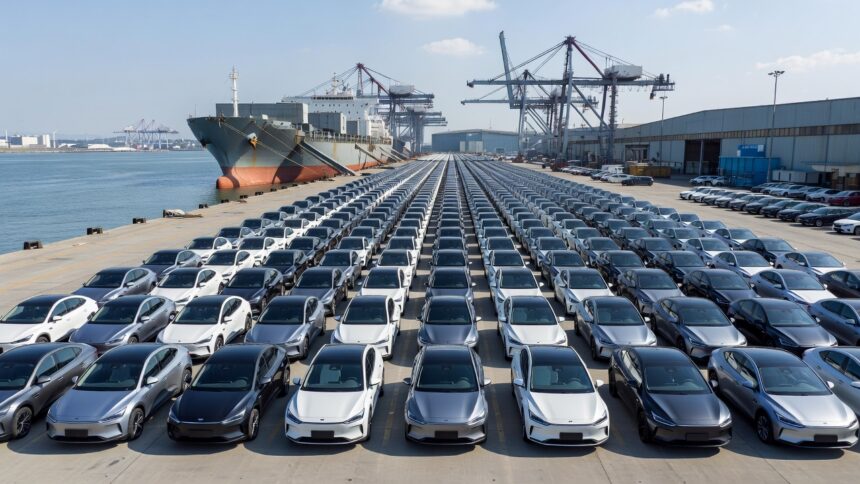


A Reuters report from Beijing highlighted the contrasting fortunes of China’s auto sector, where weak consumer demand and excess capacity have driven steady domestic declines while exports surge into markets across Europe, Southeast Asia and Latin America. The China Passenger Car Association recorded sales of 1.47 million vehicles in July, a 20 percent drop from the previous year and the 10th consecutive monthly fall. Exports climbed 88 percent to 923,000 units in the same month, with the pattern of double-digit domestic contraction and export growth holding for local brands despite the data including some foreign marques assembled in China. Secretary-general Cui Dongshu linked the latest weakness to elevated fuel prices hurting gasoline models and ongoing softness in entry-level sedans.
Domestic car sales for the first six months of 2026 fell by 2.3 million vehicles, a 20 percent decline equivalent to total new registrations in Japan over the period, the association’s figures show. This slump mirrors wider economic pressures including a faltering property sector and subdued household spending that have left factories producing more than the home market can absorb. Car exports rose 71 percent in the first half, offering vital relief to manufacturers facing intense domestic price competition. The trends have intensified incentives for companies to expand abroad, building on China’s position as the world’s largest vehicle exporter since 2023.
BYD has exemplified the shift, with a 35 percent decline in domestic sales over the first seven months more than offset by a 79 percent increase in overseas deliveries that made Brazil and Britain its top single-country markets outside China this year. The broader industry reflects an economy in which booming production and shipments prop up growth even as internal demand lags, according to the Reuters analysis. Policymakers continue to grapple with imbalances that have prompted successive stimulus efforts, yet a sharp V-shaped recovery in auto sales appears unlikely, HSBC analyst Yuqian Ding noted, though new models could help stabilise demand from late August.
Chinese brands have rapidly gained share in Europe, lifting their portion of the passenger vehicle market from 3 percent to 16 percent in the first quarter of 2026 while Japanese automakers remained near 12 percent, Counterpoint Research data indicates. The disparity is sharper in electric vehicles, where Chinese companies accounted for nearly one-quarter of shipments against under 5 percent for Japanese rivals. Many Chinese automakers are now pairing exports with local factory investments in Europe to circumvent trade barriers and deepen their foothold. This expansion adds pressure on established players such as Toyota and Volkswagen already contending with lower-cost, technologically advanced Chinese electric offerings.
Abhilash Gupta, research analyst at Counterpoint Research, said the real separation is in EVs. “This is an electrification gap, not just a price story.” Counterpoint projects Chinese brands will secure more than 20 percent of Europe’s overall passenger vehicle market and 29 percent of its EV segment by 2030. “Tariffs can slow that curve, but they’re not going to reverse it,” Gupta added. The gains come as Chinese products leverage advantages in batteries, software and rapid iteration that extend beyond the manufacturing efficiency that once propelled Japan’s export dominance.
Bill Russo, chief executive of Shanghai-based Automobility, said Chinese automakers have excess manufacturing capacity, highly competitive supply chains, increasingly sophisticated products and a strong economic incentive to find growth outside China. Going global “is becoming a strategic necessity” for leading carmakers, he added in the Reuters report. The combination of electrification expertise, supply-chain scale and swift product development could render China’s international expansion considerably more disruptive than previous waves, Russo observed. New energy vehicle penetration in China itself reached 65 percent in July even as overall sales softened, according to supplementary China Passenger Car Association estimates.