ع
ع



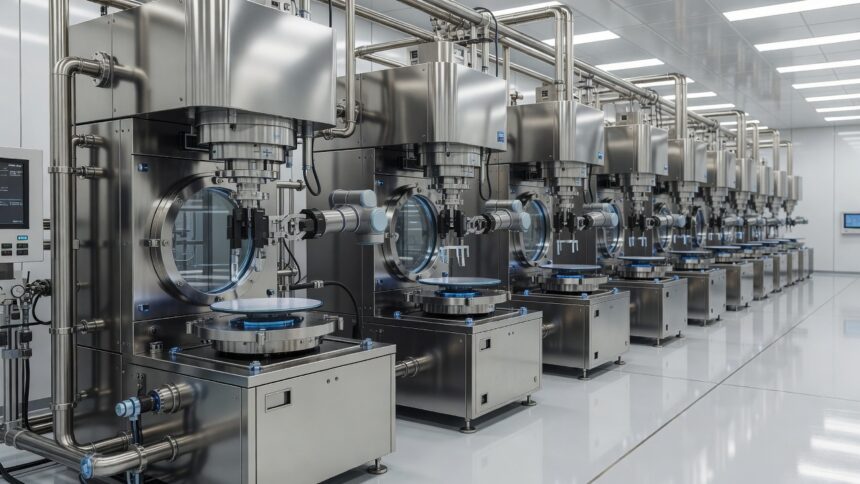


A Reuters report published this week detailed how Samsung Electronics and SK Hynix began evaluating etching tools from China’s Advanced Micro-Fabrication Equipment Inc roughly two years ago at their factories in the country. The assessments serve as a contingency should Washington impose further limits that extend beyond new imports to include maintenance and spare parts for already installed Western machinery. Three people familiar with the matter told Reuters that both memory chip producers sought to ensure operational continuity at their Chinese facilities, which form a critical part of their global supply chains.
The US Commerce Department first designated the companies’ Chinese plants as validated end users in 2023, a status revoked in 2025 before an annual license covered 2026 requirements, according to the news agency. Samsung stated to Reuters that it has not tested AMEC equipment and had not considered doing so. SK Hynix declined to comment while AMEC and the Bureau of Industry and Security offered no response to inquiries.
Facilities in locations such as Wuxi and Xian operated by the South Korean firms rely extensively on equipment from suppliers including Applied Materials and Lam Research, Reuters reported. Industry consultant Dan Hutcheson told the agency that comparable Chinese tools typically carry prices 20 to 30 percent below those of their Western counterparts. The evaluations reflect broader industry efforts to mitigate risks from export controls first introduced in 2022 and subsequently tightened.
AMEC has already supplied tools to Yangtze Memory Technologies Corp, a leading Chinese memory producer, the report noted. Successful validation by Samsung or SK Hynix would deliver substantial commercial credibility to domestic Chinese equipment vendors facing an uphill battle against established leaders. A Deutsche Bank assessment projected that AMEC, along with Naura Technology and Piotech, could each surpass $1 billion in revenue during 2026.
A Center for Strategic and International Studies analysis from last year found that the layered US controls have disrupted China’s semiconductor development while trimming revenues and on-the-ground visibility for American and allied suppliers. Congressional Research Service figures show US semiconductor manufacturing equipment exports to China totalled $4.2 billion in 2024, continuing a downward trend from $5.1 billion in 2022. Beijing has meanwhile enforced a 50 percent domestic sourcing mandate for fabrication plants, fueling rapid expansion among local firms that now include Naura in the global top 10 equipment vendors.
Significant technical and regulatory barriers still confront broader uptake of Chinese equipment, Reuters added, particularly for the most advanced memory processes that demand extensive qualification cycles. Intellectual property considerations and shifting geopolitical dynamics compound the challenges for both buyers and suppliers. The report indicated that while the tools may support less cutting-edge production lines effectively, full integration into leading facilities would require further advancements and trust-building measures.