ع
ع


By Market Insights Desk
Middle East markets opened August with the diplomatic track back in motion and Gulf supply moving at its strongest rate since the spring. Brent crude settled at $83.70 a barrel on Monday after US President Donald Trump called off a planned strike on Iran and confirmed that negotiations with Tehran would begin the same day. Trump said regional allies, including Saudi Arabia, had urged Washington toward diplomacy, and Iran confirmed that its discussions with Oman on shipping arrangements through the Strait of Hormuz were advancing.
The easing follows a July in which Brent gained close to 24 percent on supply-risk premium alone. With that premium now unwinding, attention across the region turns to volumes rather than prices, and the volume picture has improved considerably. Gulf producers have restored output at a pace that few forecasters expected in the spring, OPEC+ has completed the restoration of its 2023 voluntary adjustments, and regional debt and property markets have both reopened with force.
Supply Routes Reopen and Alternatives Firm Up
Alongside the Hormuz negotiations, Turkey and Iraq extended a key pipeline agreement by a further year, reinforcing alternative export capacity for northern Gulf barrels. Kazakhstan resumed crude intake through the Caspian Pipeline Consortium terminal after a brief suspension, restoring an important westbound route for European refiners.
Iranian Foreign Minister Abbas Araghchi described the negotiations with Muscat as nearing completion. BMI, the research unit of Fitch Solutions, said in a note on Monday that a broader diplomatic understanding on reopening the Strait remains achievable within the current quarter.
OPEC+ Completes Its Output Restoration
Seven OPEC+ producers meeting virtually on 2 August approved a production adjustment of 188,000 barrels per day for September. Saudi Arabia, Russia, Iraq, Kuwait, Kazakhstan, Algeria and Oman each take a share, with Saudi Arabia and Russia contributing 62,000 barrels per day apiece.
The increase completes the phased restoration of the 1.65 million barrels per day of additional voluntary adjustments first agreed in 2023, returning the group to full nominal capacity under that tranche. A separate layer of roughly 2 million barrels per day introduced in 2022 remains in place through the end of 2026, giving the alliance substantial headroom to add further supply as regional conditions normalise. The Joint Ministerial Monitoring Committee, meeting the same day, reviewed May and June production data and reaffirmed the importance of safeguarding international maritime routes to ensure uninterrupted energy supplies. The next ministerial meeting is scheduled for 6 September.
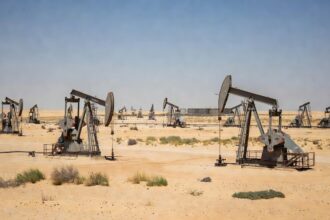
Gulf export volumes have tracked the policy. Kuwait raised average crude output to 1.971 million barrels per day in July, up from 1.65 million in June and 580,000 in May, according to a source cited by Reuters. Saudi Arabia posted the largest single increase within OPEC+ during the recovery, lifting output from 6.44 million barrels per day in May to 7.34 million in June, according to the International Energy Agency.
Abu Dhabi Leads GCC Equities
The FTSE ADX General Index closed July at 9,914.6 points, up 1.1 percent for the month and marking a second consecutive monthly advance, according to Kamco Invest. The gain was led by financials, up 2.2 percent, and telecommunications, up 5.7 percent, with First Abu Dhabi Bank rising 14.1 percent over the month and buying interest extending to Americana Restaurants, NMDC Group and Abu Dhabi Commercial Bank in the final week.
Vijay Valecha, Chief Investment Officer at Century Financial, noted that the index has broken above its 200-day exponential moving average near the 9,887 level, a structure he described as tilted toward the upside, with 9,947 the next resistance zone.
The International Monetary Fund reiterated its confidence in the UAE economy during the month, forecasting 2.4 percent growth for 2026 and highlighting the country’s resilience, strong policy buffers and capacity to absorb regional shocks.
Oman and Saudi Arabia Hold the Year’s Strongest Returns
Oman’s MSX 30 remains the standout performer of 2026, up 24 percent year to date and holding the top position across the GCC through a period of considerable regional volatility.
Saudi Arabia’s Tadawul All Share Index holds the region’s second-best year-to-date performance at 0.9 percent, supported by strong corporate earnings, steady foreign investment and the momentum behind Vision 2030 diversification. Healthcare equipment and services rose 3.7 percent in July, energy gained 1.3 percent and telecommunication services added 0.5 percent. Saudi Aramco advanced 1.4 percent and Rabigh Refining and Petrochemical Co. surged 21.7 percent as investors positioned in established energy names. Among lenders, Bank Aljazira, Arab National Bank and Saudi Awwal Bank each gained more than 4.5 percent. Tabuk Agricultural Development Co. led July’s gainers with a 47.5 percent rise.
Foreign holdings on the Saudi Exchange stood at SR437.87 billion, or $116.77 billion, at the end of July. The exchange ranks 13th globally by market capitalisation at SR9.45 trillion, with average daily traded value of SR3.91 billion for the month.
Kuwait Ranks Among the Region’s Most Resilient Markets
Boursa Kuwait reported net profit of KD 13.74 million for the first half of 2026 and ranked third among GCC capital markets by All-Share Total Return Index performance, behind Muscat and Riyadh. The index posted growth of 0.2 percent over the half, placing Kuwait among only three Gulf markets to deliver a positive return during the period.
Total trading value reached KD 9.82 billion, with institutional investors accounting for 70.08 percent of market activity and international investors 18.79 percent of total value traded. Chairman Bader Al-Kharafi pointed to the recovery in second-quarter earnings and the exchange’s continued transformation toward a multi-asset market through the launch of its fixed-income platform and the introduction of exchange-traded funds.
Dubai Property Accelerates as Valuations Turn Attractive
Dubai property transactions rose 16.9 percent month on month to AED 56.1 billion in July, according to Kamco Invest, with residential supply continuing to expand against sustained demand.
The DFM General Index consolidated at 5,795.9 points after a strong start to the year, leaving the benchmark trading at a 12-month forward price-to-earnings ratio of around 9.8 times. Valecha described those levels as appealing for investors seeking exposure to the emirate’s long-term growth story. Defensive and consumer-focused names including Spinneys 1961 Holding, Commercial Bank of Dubai, DEWA, du and Dubai Taxi were among the notable performers during the month.
Debt Markets Reopen at Scale
GCC bond and sukuk issuance reached $102.69 billion across 161 primary issues in the first half of 2026, up 6.5 percent on the $96.42 billion raised a year earlier, according to Markaz. Average issue size rose from $406.8 million to approximately $637.8 million as issuers consolidated into fewer, larger transactions.
Saudi entities led with $49.34 billion, or 48 percent of the total, followed by the UAE at $25.45 billion, Qatar at $12.4 billion, Kuwait at $8.7 billion, Bahrain at $4.0 billion and Oman at $1.8 billion. Financial institutions accounted for 40.6 percent of issuance value and governments for 35.1 percent, with dollar-denominated paper representing 81.2 percent of the total. Five-year sovereign credit default swap spreads tightened across all GCC markets from March levels, with Oman and Saudi Arabia ending the half inside where they began the year.
Banking Fundamentals Hold Firm
Fitch Ratings expects GCC banks’ credit fundamentals to remain resilient through the second half of 2026, supported by strong capital and liquidity buffers and healthy asset quality. Funding and liquidity have emerged as ratings strengths for a sector that is predominantly deposit-funded, with sticky government and government-related deposits accounting for 20 to 30 percent of total sector deposits.
Market access has proved more durable than expected, with major issuers returning to public debt markets at minimal additional risk premium, including in the subordinated space. GCC central banks in the UAE, Kuwait and Qatar have maintained liquidity, capital and asset-quality support packages, and the region’s banks have not experienced significant deposit outflows through the period.
Outlook
The near-term variable is the pace of the Hormuz reopening and the timetable that emerges from this week’s talks. A durable arrangement would restore full export volumes, relieve the freight and insurance costs that have weighed on regional trade since the spring, and unlock an IPO and issuance pipeline that has been building throughout the year.
The underlying position is strong. Gulf sovereigns retain substantial accumulated liquid assets, alternative export routes have been reinforced, banking systems carry ample buffers, and valuations across the region’s larger markets sit well below their recent peaks. Abu Dhabi’s leadership, Oman’s sustained outperformance, Saudi Arabia’s year-to-date resilience and Dubai’s property momentum all point to a region positioned to convert normalisation into growth as the diplomatic track advances.