ع
ع


Saad Sherida Al-Kaabi, who also serves as president and chief executive of QatarEnergy, thanked neighboring countries for permitting potential pipeline use across their territories to avoid the Strait of Hormuz during remarks at the Qatar Economic Forum. The minister stressed that not every commodity lends itself to pipeline transport, highlighting LNG as Qatar’s principal export product that requires liquefaction and marine shipping. Al-Kaabi made the comments in a panel discussion titled “The Global Energy Realignment” at the forum’s first edition hosted in New York to align with high-level meetings of the 81st United Nations General Assembly.
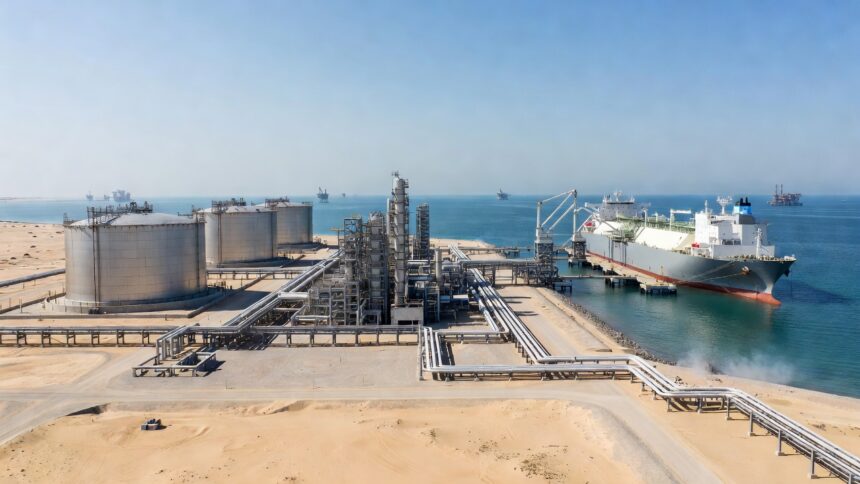
“We are grateful for our neighbors who have welcomed us to use their territories. However, not everything can be transported via pipelines. The problem is that LNG, our main export commodity, cannot be transported by pipelines,” Al-Kaabi said. He explained that any pipeline solution would necessitate moving gas in its gaseous form before re-liquefying it at receiving terminals, resulting in construction of duplicate facilities alongside those already advancing in Qatar under the North Field expansion. “This makes no economic sense,” the minister added, according to his address at the forum.
Al-Kaabi stated that Qatar has decided against pursuing pipelines as an alternative after evaluation against commercial and technical standards. The North Field project ranks among the world’s largest natural gas developments, focused on elevating Qatar’s LNG output capacity in coming years. A report by the International Energy Agency has consistently positioned Qatar as a cornerstone supplier in global LNG markets, where seaborne trade volumes have expanded steadily amid shifting energy demand patterns across Asia and Europe.
The minister turned to QatarEnergy’s expanding footprint in the United States, confirming that shipments commenced from the first train at the Golden Pass LNG facility. He projected that the second and third trains at the terminal will achieve full operations next year. Al-Kaabi noted that the Golden Triangle Polymers initiative, which includes the world’s largest ethane cracker, entered its commissioning phase with startup anticipated within weeks.
Qatar’s energy strategy centers on maintaining its status as a reliable LNG supplier while navigating regional maritime chokepoints such as the Strait of Hormuz, through which much of its tanker traffic passes. The minister’s remarks underscore the technical barriers inherent in adapting pipeline infrastructure for LNG, which must remain in a cryogenic liquid state incompatible with standard pipelines. Industry assessments from bodies like the US Energy Information Administration affirm that LNG transport relies overwhelmingly on specialized vessels rather than fixed pipelines.
The Qatar Economic Forum provided a platform for Al-Kaabi to address broader realignments in global energy flows, including responses to geopolitical pressures around key shipping lanes. His position reflects a preference for established LNG value chains over hypothetical pipeline networks that would demand additional liquefaction infrastructure at destination points. QatarEnergy continues to advance its international partnerships, including in North America, to diversify delivery options while upholding core project timelines at home.