ع
ع


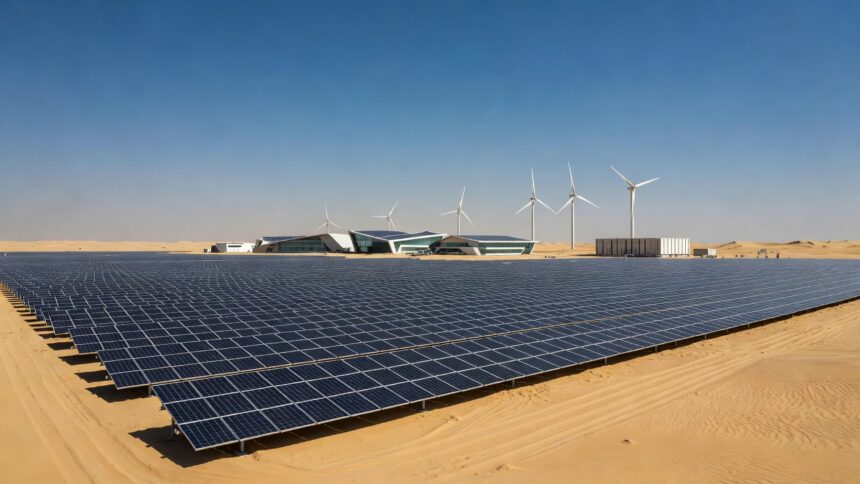


Robin M. Mills, chief executive of Qamar Energy, wrote in The National that Saudi Arabia earned about $190 billion from petroleum sales in 2025 while China generated roughly $240 billion from clean-tech exports in the same period. Mills pointed out that even under optimistic OPEC projections, oil and gas sales for OPEC+ nations are unlikely to grow by more than 1 per cent annually through 2050, a pace insufficient to fulfil the economic aspirations of the UAE, Saudi Arabia and neighbouring states. The column emphasised that several Gulf countries have already established leadership in low-cost solar power installations, with battery storage and hydrogen production projects scaling up rapidly across the region.
According to the article in The National, these renewable advances deliver lower carbon footprints for domestic energy systems while matching the reliability of traditional fossil fuel generation. National clean energy champions including Masdar in the UAE, Acwa Power in Saudi Arabia, OQ Alternative Energy in Oman and Nebras Power in Qatar have assembled international portfolios spanning the Middle East, Africa, Central Asia, India and Europe. A separate report in The National detailed Masdar’s commitment of $15 billion to global clean energy projects throughout 2025, targeting solar, wind and battery storage across more than 40 countries.
Mills identified abundant capital, exceptional renewable and fossil resources, geological potential for carbon capture, and an openness to risk as key Gulf advantages in The National column. The piece called for Gulf institutions such as Khalifa University, American University of Sharjah and NYU Abu Dhabi to expand their roles as intellectual centres by attracting researchers affected by funding constraints or policy shifts elsewhere. It further advocated creation of large-scale innovation companies valued in the tens of billions of dollars, employing around 10,000 staff, generating most revenue from exports and maintaining strong domestic economic linkages.
An IRENA assessment found the Middle East recorded a 28.9 per cent rise in renewable energy capacity in 2025, led by Saudi Arabia, as part of broader global trends where renewables comprised 85.6 per cent of new power additions. A Columbia University Energy Policy Center analysis estimated the GCC must invest nearly $60 billion from 2025 to 2030 to deploy an additional 102 gigawatts of renewable capacity toward its 2030 targets, after connecting only 19.3 gigawatts of 62.1 gigawatts under development as of mid-2025. The World Future Energy Summit, hosted by Masdar at the ADNEC Centre from January 13 to 15, 2026, featured discussions on grid flexibility, decarbonisation and cleantech innovation as part of Abu Dhabi Sustainability Week.
The National column highlighted specific innovations including Omnipower’s direct current upgrades to triple existing grid route capacity, 44.01’s mineralisation of carbon dioxide in Fujairah underground formations and NEG8 Carbon’s direct air capture system powered by off-grid renewables suited to arid conditions. It also referenced Nanoplume’s bio-based aerogel insulation, Made of Air’s carbon-trapping biofilm materials, Altilium’s extraction of materials from mining waste and Litus’s lithium recovery from brines and oilfield waters. Additional transformative technologies cited encompass CubicPV’s high-efficiency perovskite solar panels, Electric Aviation Group’s zero-emission aircraft concepts and Helical Fusion’s pursuit of sun-like fusion reactions for limitless clean power.
Mills noted in the column that the Zero-Emissions Traders Alliance is advancing payment mechanisms for carbon removal, sequestration and related approaches, with contributions from figures such as Jan Haizmann of Zeta and Vahid Fotuhi of Blue Forest using mangrove systems. Battery energy storage markets in the GCC are projected to expand at more than 30 per cent compound annual growth this decade, according to industry outlooks referenced in summit materials, unlocking applications in grid services and peak shaving. The summit platform, which attracted more than 800 global brands and featured a dedicated cleantech pavilion, served to accelerate collaborations on these fronts amid the regional push toward net-zero pathways.