ع
ع




The Ministry of Economy reported that the UAE economy expanded by around 5.1 percent in the first nine months of 2025 to reach approximately AED1.4 trillion. Non-oil growth stood at 6.1 percent in the same period according to the ministry’s data. Full year figures later showed GDP rising 6.2 percent to Dh1.9 trillion with the non-oil economy expanding 6.8 percent to Dh1.5 trillion a report in The National indicated in May 2026. Non-hydrocarbon sectors accounted for more than 70 percent of GDP according to the Central Bank of the UAE.
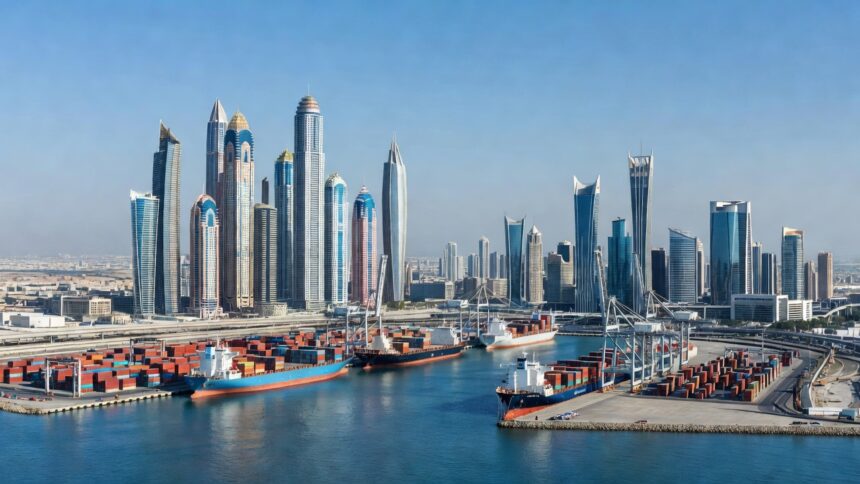
Non-oil foreign trade surpassed AED3.8 trillion, or about 1 trillion dollars, in 2025 for the first time the Ministry of Economy stated. This development reflects the UAE’s strategic role linking Europe, Asia and Africa through its diversified economy. The Central Bank of the UAE has attributed the performance to strong results in manufacturing, financial services, tourism, logistics and construction sectors. Investment in aviation, digital infrastructure, finance, clean energy and advanced logistics has positioned the country as a central node in global commerce according to the analysis.
Forecasts from the Central Bank of the UAE suggest real GDP growth could remain close to 5 percent through 2026 supported by non-oil expansion. Its September 2025 quarterly review projected 4.9 percent growth for 2025 and 5.3 percent for 2026. The International Monetary Fund projected real GDP growth of 3.1 percent for the UAE in 2026 according to its April 2026 outlook. These projections incorporate rising investment in technology, advanced manufacturing and renewable energy the bank assessment found.
Zahara Sadiq, chief economist at Economy Middle East, noted in the March 11 article that diversification and connectivity fundamentally change how an economy absorbs shocks. She stated that countries reliant on narrow export bases often experience sharper volatility during global disruptions while economies embedded across multiple sectors tend to demonstrate greater resilience. Sadiq added that the next phase of growth is increasingly expected to come from knowledge-driven sectors rather than hydrocarbons alone.
Sadiq, who has worked in the UAE and United Kingdom for more than 15 years, said she has considerable confidence in the country’s leadership and ability to navigate periods of uncertainty. “Having observed the evolution of the UAE economy over more than fifteen years, I have considerable confidence in the country’s leadership and its ability to navigate periods of uncertainty,” Sadiq said. Strategic initiatives including expanded trade partnerships, economic diversification programs and investments in future industries demonstrate a clear commitment to shaping the long-term economic trajectory she wrote.
The UAE has concluded more than 20 comprehensive economic partnership agreements that have bolstered its position as a global trade hub a New Zealand Ministry of Foreign Affairs and Trade update from March 2025 reported. Non-oil activity now drives more than three-quarters of GDP and foreign investment rose almost 49 percent year on year according to Forbes MENA. The country aims for AED 4 trillion in non-oil trade by 2031 through continued policy focus on logistics, infrastructure, food security, energy, artificial intelligence and fintech the update added.