ع




The Qatar Investment Authority established Qai as a wholly owned subsidiary in December 2025 to drive national artificial intelligence initiatives, the fund announced at the time of its formation. Qai immediately entered a $20 billion joint venture with Brookfield to build integrated AI compute facilities in Qatar and explore additional projects abroad. A subsequent analysis by Strategy& Middle East projected the domestic AI market to exceed $2 billion by 2030, split across platforms, products, professional services and infrastructure segments. The consultancy’s assessment identified sovereign AI applications for regulated industries as a promising area where Qatar could develop solutions with export potential across the Gulf.
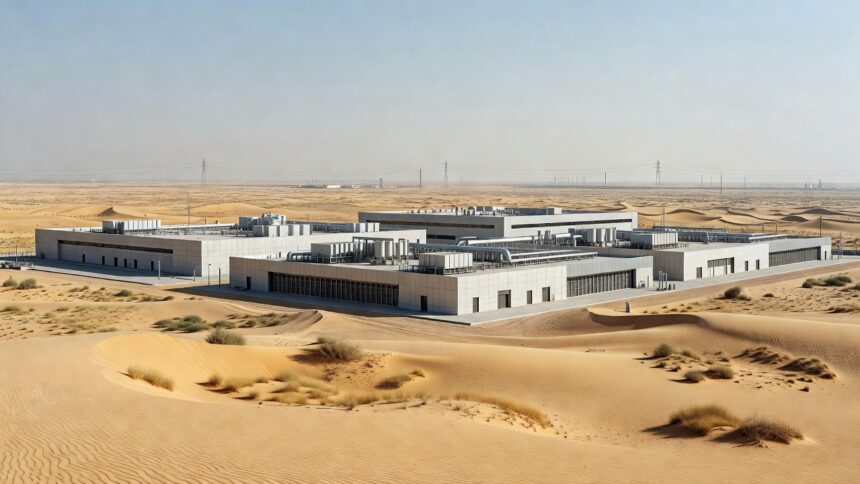
Reuters reported in December 2025 that Qatar is relying on its cheaper electricity to overcome the elevated cooling costs associated with desert-based data centres. The news service cited Knight Frank data that places Middle East power usage effectiveness ratings at 1.79 compared with a global average of 1.56. Stephen Beard, global head of data centres at Knight Frank, told the outlet that Qatar could reach a 1.5 to 2 gigawatt market by 2030 if it sustains its energy advantage and accelerates regulatory alignment with Western data privacy standards. Wedbush analyst Dan Ives separately forecast $800 billion in AI data centre buildout spending across the Middle East over the ensuing two years.
National efforts to secure data within borders have shaped model development, according to technical documentation from the Qatar Computing Research Institute. The institute’s Fanar large language model incorporates sovereignty as a core design principle applied from data curation through to deployment, producing a corpus of roughly 120 billion high-quality Arabic tokens. Accenture research covering Saudi Arabia, the UAE and Qatar found that 54 percent of regional organisations prioritise sovereignty or residency requirements at the data layer, while 31 percent focus on the infrastructure layer. This emphasis aligns with Qatar’s 2016 data protection law and the 2019 National AI Strategy that continues to guide policy.
Ooredoo’s digital infrastructure arm Syntys has expanded local capacity through acquisitions and now targets more than 120 megawatts across the Middle East and North Africa by 2030, the operator stated in corporate updates. The unit launched Nvidia-powered sovereign AI cloud services hosted entirely within Qatari data centres that operate under national data policies. Additional partnerships with Cisco and Scale AI, announced in late 2025 and 2026, supply networking, security and high-quality training data tailored to government priorities in healthcare, education and justice. Meeza, listed on the Qatar Stock Exchange, has similarly secured financing to triple its colocation capacity within four years.
Challenges remain in securing advanced chips subject to United States export controls and in attracting global talent, a Reuters assessment noted. Beard highlighted that replicating American-style data governance will prove critical for large-scale hyperscaler participation. Despite these constraints, Qatar’s $526 billion sovereign wealth fund provides capital depth that complements its structural energy advantage derived from North Field LNG expansion projects. The country currently raises liquefied natural gas capacity toward 126 million tonnes annually, a resource that both powers domestic compute and supplies global markets facing rising AI-driven electricity demand.
The combined approach positions Qatar to develop AI infrastructure that balances local control with international collaboration, according to multiple industry reports published in 2026. Strategy& emphasised that Qatar can focus on areas of genuine advantage rather than attempting to master every layer of the AI value chain. Such targeted development could convert domestic deployments into scalable products for energy, finance and logistics sectors shared across the Gulf.