ع
ع



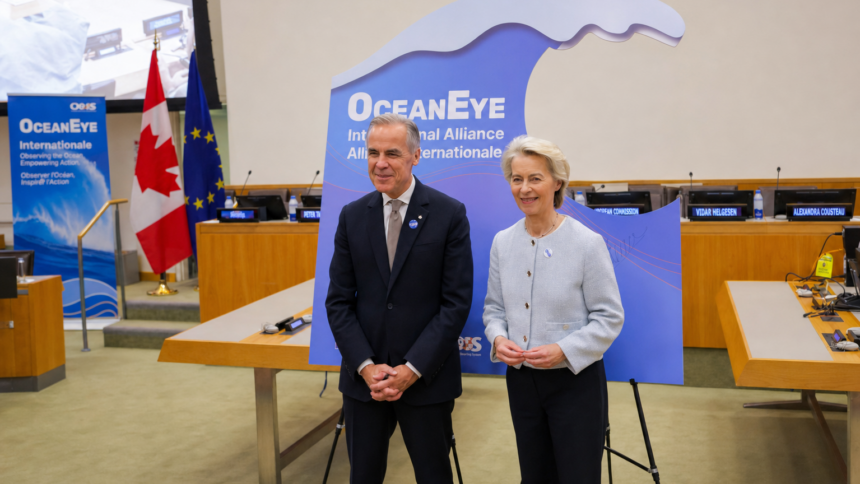


European Commission President Ursula von der Leyen and Canadian Prime Minister Mark Carney launched the OceanEye International Alliance at the United Nations General Assembly in New York on September 23, 2026, drawing more than 30 countries and the European Union as initial members. The alliance seeks to sustain and expand the Global Ocean Observing System through coordinated investment and improved data access for essential services ranging from disaster warnings to coastal resilience. A European Commission announcement placed the combined pledges from all partners at a minimum of €211 million, incorporating financial contributions alongside in-kind support such as research vessels, sensors and data processing facilities.
The European Union provided a seed contribution of €92 million from its Horizon Europe program while Canada committed 82 million Canadian dollars over five years to broaden its ocean observation capacity, according to statements from the co-chairs. Additional partners offered assets including drones and satellites to fill gaps in high-seas coverage and space-based monitoring. The pledges aim to protect existing observation networks that have accumulated decades of ocean records while addressing vulnerabilities exposed by reliance on short-term funding.
The Global Ocean Observing System delivers more than 120,000 ocean observations daily and underpins weather forecasts, climate models and maritime navigation across dozens of nations. An Intergovernmental Oceanographic Commission assessment found that 64 countries contribute data to the system yet 90 percent of global observations come from just nine funding sources, leaving the network susceptible to budget shifts. The commission’s 2025 Status Report determined that the observing system remains subcritical despite incremental gains in coverage for marine heatwaves and biodiversity tracking.
OceanEye will develop new technologies and install additional equipment to close monitoring gaps that currently limit accurate predictions of extreme events and ecosystem changes. European Commission President Ursula von der Leyen stated, “We must listen to the ocean and we must protect it much more. And yet, ocean observation is under huge pressure. The global network that provides this data faces a critical funding shortfall.” The alliance builds on longstanding efforts by the Intergovernmental Oceanographic Commission to coordinate sustained ocean observations as part of the Global Earth Observing System of Systems.
Participating nations include Angola, Brazil, Chile, France, Germany, the United Kingdom, South Korea and several others spanning Europe, Africa and the Americas, a World Resources Institute statement noted. The initiative responds to growing demands for ocean data to support food security, coastal protection and sustainable economic activities amid accelerating climate impacts. Further expansion of the alliance is expected to diversify funding streams and reduce dependence on a narrow group of contributors.
Funding will target enhancements in essential ocean variables such as temperature, salinity and biodiversity indicators that inform both scientific research and operational services. A World Meteorological Organization review highlighted that real-time ocean observations are indispensable for early warnings of tropical cyclones, heavy rainfall and other hazards affecting coastal communities. Officials indicated the September 23 event at the UN General Assembly represented an initial step toward securing long-term resources for the global observing infrastructure.