ع
ع



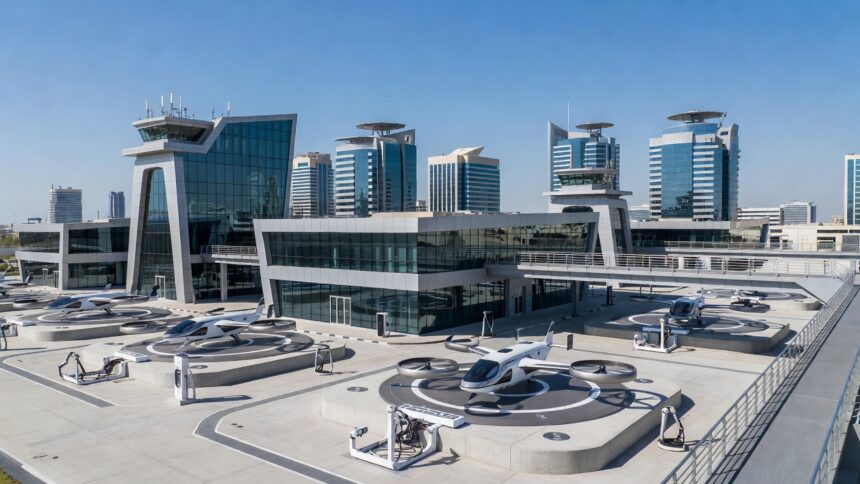


A Morgan Lewis assessment published in July 2026 outlined how the Gulf Cooperation Council states have taken an operations-led path to advanced air mobility, enabling regulation, vertiports, air corridors, airspace management and early commercial deployment to develop in tandem. The publication highlighted that the defining feature of the GCC approach is the speed of regulatory response rather than the comprehensiveness of any single instrument. Gulf regulators have leveraged fast policy networks to integrate multiple authorities at federal and local levels around workable solutions before completing a fully robust regulatory landscape.
The assessment found that the UAE frames advanced air mobility specifically as an urban mobility solution in response to rapid population growth in its major cities, which has sharpened the commercial case and driven urgency toward operations. AAM stakeholders benefit from broad policy support, including promotion of public-private partnerships, with regulators giving operators space to address regional challenges such as extreme weather and dense airspace through collaborative negotiation. The policymaking remains active, as evidenced by initiatives like a memorandum of understanding involving Boeing’s Saudi entity, the civil aviation regulator and a national university for operational feasibility analysis including AI models for airspace management.
According to separate research by LYNEports released in June 2026, a context-specific operational framework for advanced air mobility in the GCC focuses on infrastructure readiness tailored to the Gulf’s urban fabric, climate conditions and airspace structure. The LYNEports document details vertiport planning across urban, suburban, airport-linked, tourism and intra-development settings while outlining a phased operational pathway through 2031. This framework distinguishes between achievements possible under current conditions and those dependent on future maturity of aircraft, infrastructure and airspace.
Global Stratalogues launched a report in February 2026 following a roundtable in Riyadh that emphasised treating advanced air mobility as an infrastructure and systems challenge rather than solely aircraft innovation. The report recommended formation of a national AAM task force, phased corridor pilots, modular vertiport investment and workforce development to support Saudi Arabia’s Vision 2030 goals. Participants highlighted the need for integration with existing airport ecosystems, airspace systems, power capacity and long-term planning.
Data from industry analyses indicate that Middle East carriers are projected to achieve the highest global net profit margin of 9.3 percent in 2026, bolstered by the region’s strategic position as a connecting hub and positive regulatory environment, according to IATA figures. This performance complements the advanced air mobility push, with projects like vertiports in Dubai and partnerships with manufacturers such as Joby Aviation advancing rapidly. Dubai Airports has reported construction progress on multiple vertiport sites expected to come online during 2026.
Regulatory harmonisation across the GCC, including Bahrain’s recent alignment with unified aviation standards, is reducing operational friction for carriers and supporting seamless mobility, a Gulf magazine review stated in December 2025. The unified approach enhances the region’s influence in global aviation forums and aligns with international benchmarks from bodies like the FAA and EASA. Such coordination extends to advanced air mobility, positioning the Gulf to set rather than follow global agendas in the sector.