ع
ع



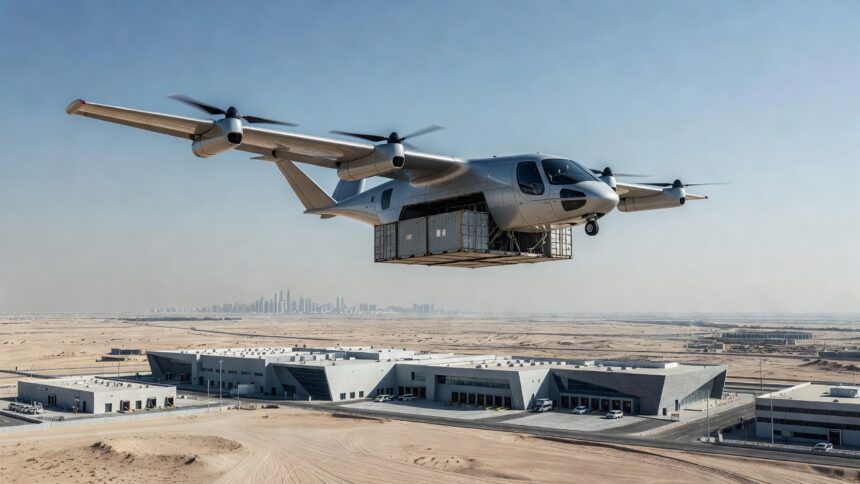


An assessment by LYNEports has ranked cargo and logistics third in near-term viability for advanced air mobility missions in the GCC, following medical and government applications while preceding general urban passenger air taxi services. The review noted that cargo operations sidestep passenger certification requirements and public acceptance variables that complicate earlier rollout of passenger eVTOL flights. These freight missions also establish air corridors and supporting infrastructure that can transition to mixed-use operations once regulatory frameworks mature further. Cargo applications further align with industrial priorities under Saudi Vision 2030 and parallel development goals in the UAE and wider Gulf.
Mordor Intelligence data places the GCC air freight transport market at $16.81 billion in 2024 with expectations to reach $24.08 billion by 2029, reflecting a compound annual growth rate of 7.46 percent. That expansion stems from rising e-commerce volumes, industrial projects and demand for accelerated supply chains linking free zones and giga-developments. Sector specialists have highlighted how eVTOL platforms can furnish runway-free links suited to time-critical shipments including medical supplies and high-value components.
Falcon Aviation Services committed last year to 15 Autoflight V2000CG cargo platforms for routes serving the Abu Dhabi National Oil Company with the initial batch scheduled for delivery during 2026, a FlightGlobal compilation showed. The same operator signed for 35 passenger versions of the V2000EM although those aircraft have yet to secure certification. Early cargo deployments furnish operators with operational data on performance in the Gulf’s high-temperature and dusty environment.
Abu Dhabi-based LODD paired drone delivery with its Hili hybrid cargo aircraft that completed test flights in Al Ain during late 2025, an Aviation Business ME sector review reported. The platform carries up to 250 kilogrammes across 300-kilometre ranges using vertical electric lift followed by combustion-engine cruise. Developers have targeted repeatable middle-mile routes between logistics hubs and hospitals rather than last-mile consumer deliveries.
The UAE General Civil Aviation Authority has mapped national corridors for piloted and autonomous air taxis together with cargo drones under a framework announced in early 2025 with implementation timelines of roughly 20 months, official statements confirmed. Parallel regulatory work in Saudi Arabia and Bahrain has focused on integrating these systems into existing airspace while prioritising safety and efficiency standards. Such preparatory steps have positioned the Gulf ahead of many global regions in advanced air mobility infrastructure planning.
LYNEports analysts observed that beginning with cargo reduces technical and regulatory risk while generating the flight hours and performance metrics required before passenger services scale. Vertiport designs can remain compact and modular when initially optimised for freight, lowering unit costs as networks expand. Industry participants expect the cargo-first sequence to compress overall timelines for eventual passenger air taxi networks across multiple GCC cities.
Additional regional programmes include Oman-based initiatives with hybrid VTOL platforms and Saudi partnerships involving Archer Aviation and Joby Aviation that incorporate cargo-capable variants alongside passenger testing, separate aviation reports indicated. These layered efforts illustrate a deliberate progression from freight validation to broader mobility applications throughout the Gulf market.