ع




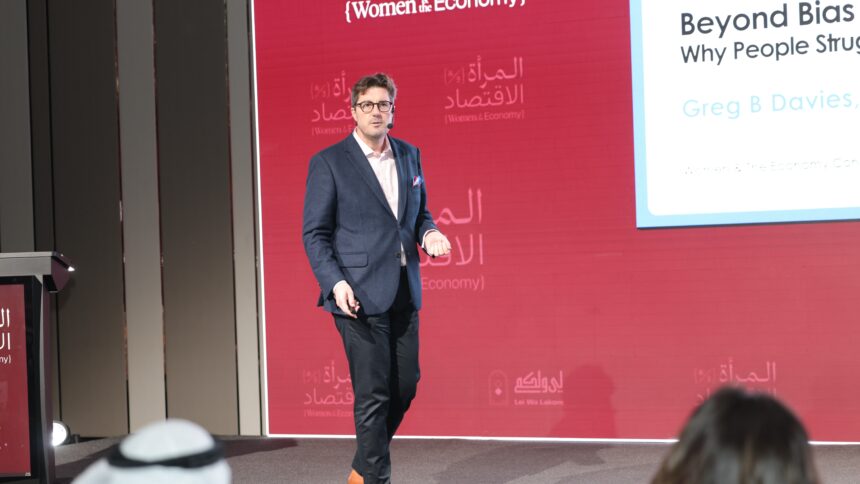


Oxford Risk’s Dr Greg B Davies tells Diwaniya Media that portfolios spread across different sectors may still depend on the same AI investment cycle.
A semiconductor designer, a data-centre operator and an electricity supplier can look like three separate investment choices. Each runs a different business, yet expectations for all three may depend partly on the same expansion in AI infrastructure. Dr Greg B Davies believes that investors need to look more closely at such connections before concluding that a portfolio spread across several sectors is well diversified.
Speaking to Diwaniya Media, Oxford Risk’s Head of Behavioural Finance argued that the reach of AI funding has made those underlying relationships more important. “It’s almost getting to the point where it doesn’t matter what sector of the economy you’re investing in,” he said. “It’s an AI play in some way or another.” He presented that as a warning about increasingly shared exposure, while declining to predict how far the investment boom would run.
Looking beyond the sector labels
“What I do think is the pervasive nature of AI funding has changed the nature of diversification in investing somewhat,” Davies said. The issue is that different holdings can provide exposure to different companies without providing as much separation from a common risk as the investor expects. A company’s business description may explain what it sells, but reveal less about the spending decisions or commercial assumptions on which its expected growth depends.
In the illustrative portfolio of a chip designer, data-centre operator and electricity supplier, a change in infrastructure spending could affect several holdings through different channels. A supplier might receive fewer new orders, while an operator could face a change in demand for capacity. The effect on an electricity business would depend on its customer base and contractual arrangements. These are possible mechanisms, rather than a prediction that the businesses would respond identically.
An investor could therefore reduce exposure to the failure of any single company while retaining substantial dependence on one expansion. Davies described the result directly: “So your perceived diversification is actually far greater than your actual diversification.” His warning concerns the confidence investors place in their portfolio’s construction. A larger collection of holdings may still leave them exposed to an assumption they have repeated across several investments.
The scale of the infrastructure buildout
Capital expenditure by the largest technology companies exceeded $400 billion in 2025, according to the International Energy Agency’s April 2026 report, which projected another 75% increase in 2026. The total covers broader technology-company spending and is not exclusively AI expenditure. Separately, the agency reported that electricity consumption by AI-focused data centres increased by 50% in 2025.
The spending connects a digital technology to businesses supplying physical capacity. Computing equipment needs facilities, electricity and supporting infrastructure, giving companies outside the software industry a commercial interest in the pace of expansion. For an investor, the relevant question becomes how much of a particular holding’s expected earnings depends on that demand, and how much comes from other activities. The presence of several industries in the portfolio does not resolve that question by itself.
Microsoft’s annual report for the year ended June 2026 said it would continue capital expenditure to support cloud growth and AI training and infrastructure. A spending commitment of that kind can create opportunities for other businesses, but the economic terms differ along the chain. The company buying capacity, the supplier receiving an order and the investor financing a project do not necessarily share the same returns or protections. Their fortunes can nevertheless remain connected to the continuation of the programme.
The IEA also found that valuations of selected gas-turbine and electrical-equipment manufacturers, nuclear companies and energy startups had become more closely linked to AI. Its analysis did not show a general uplift across the energy sector. That finding supports examining particular companies and their relationships with AI demand, rather than treating an entire sector as either exposed to the technology or separate from it.
Contracts, customers and financing arrangements can all change the nature of that exposure. An established asset with committed customers may have different sensitivities from a proposed development dependent on future demand. A diversified supplier may be less dependent on a particular spending programme than a business built around it. These distinctions do not remove Davies’s concern; they explain why assessing it requires looking beneath the broad investment theme.
Preparing without predicting the turning point
When asked whether AI spending was becoming problematic or would continue expanding, Davies declined to offer a market forecast. “My only honest answer there is I don’t know,” he said, explaining that he did not have differentiating expertise in that area. “And partly because I suspect nobody really knows.” He was drawing a boundary around what he could confidently assess, while identifying a consequence of the funding boom that investors could already examine.
That uncertainty leaves room for several outcomes. Continued expansion could support businesses across the supply chain, while slower spending could affect them in different ways. Improvements in the efficiency of AI could also change the economics for buyers and sellers of computing services. Owning companies on different sides of those relationships may create meaningful differences in exposure, but those differences need to be understood rather than inferred from their sector classifications.
For portfolio assessment, Davies’s argument shifts attention towards the expectations shared by the holdings. How much depends on continued infrastructure spending? Which businesses rely on the same customers? What happens if demand develops more slowly than anticipated? Those questions can be examined without claiming to know whether AI is overvalued or when investment might slow. They address the resilience of a particular portfolio across possible outcomes.
Davies said “there are consequences that we do need to plan for just by observing the extent of that funding”. His point was that investors do not need a confident prediction about the end of the boom to recognise an existing concentration. A portfolio can contain a range of businesses and still depend heavily on one source of growth. Understanding that dependence would give investors a more accurate account of the risk they have chosen to hold.