ع
ع



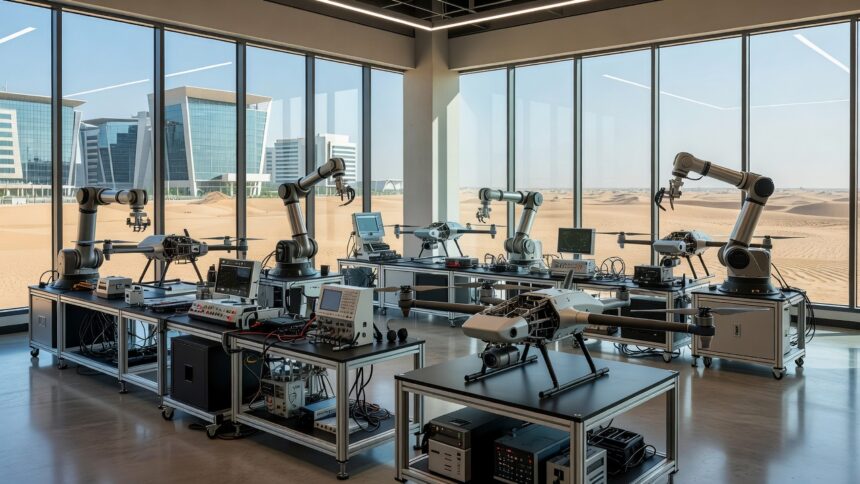


The Ministry of Commerce and Industry has targeted creation of a fully sovereign UAV sector valued at $150 million that stands ready for exports by 2032 as authorities move to localize advanced manufacturing capabilities. This objective forms a key element within the Qatar National Manufacturing Strategy for 2024-2030, which sets out to lift the industrial sector’s value addition to QAR 70.5 billion while pushing non-hydrocarbon exports above QAR 49 billion by the end of the decade. The blueprint encompasses 15 core initiatives together with 60 separate projects designed to achieve 50 percent diversification across manufacturing activities and to position Qatar among the top 40 nations on the Competitiveness Industrial Index. Such steps reflect a sustained push to reduce reliance on hydrocarbons through targeted investments in high-technology domains including unmanned systems.
A memorandum of understanding signed in January 2026 between Turkish defense specialist STM and Qatar’s Barzan Holdings at the DIMDEX exhibition focuses on joint production and co-development of tactical UAV systems within the country. STM said in a statement that the pact would enable local manufacturing, integration and capability upgrades for its tactical UAV platforms already preferred by more than 15 countries across four continents. The agreement also opens the door to collaboration on unmanned naval platforms while STM supplies engineering, systems development and technology integration support to its Qatari partner. Barzan Holdings CEO Mohammed Al Sadah joined STM General Manager Özgür Güleryüz for the signing ceremony attended by senior Qatari and Turkish defense officials.
A Data Bridge Market Research assessment projects the overall Qatar unmanned aerial vehicle market to reach $304.07 million by 2032 while expanding at a compound annual growth rate of 13.05 percent from 2025 levels.include render_inline_citation with citation_id is 21 The defense and security segment commanded the largest share in 2024 with revenue of $60.62 million according to the same outlook. Rotary-wing platforms represented the dominant product category that year while intelligence, surveillance and reconnaissance functions led demand among end uses. The forecast underscores rising interest in hybrid and specialized UAV configurations tailored to both military and commercial requirements across the Gulf state.
GlobalData figures show Qatar’s defense budget climbing at a compound annual growth rate of 3.8 percent to an estimated $20.8 billion by 2031 after an allocation of roughly $17 billion in 2026. Unmanned platforms occupy a central place in ongoing modernization programs that address regional security dynamics and manpower constraints. The United States has cleared potential sale of eight MQ-9B remotely piloted aircraft along with associated munitions to strengthen Qatar’s intelligence, surveillance, reconnaissance and strike capabilities. These acquisitions complement domestic efforts to build sovereign production capacity rather than depend exclusively on off-the-shelf imports.
Qatar Coast Guard received its first Turkish-built ULAQ 11 armed unmanned surface vessel in December 2025, marking the platform’s debut export and initial operational deployment in the Gulf. Officials have signaled plans to scale an unmanned fleet that could eventually carry out the majority of routine maritime security missions once doctrine, training and requirements are fully validated through the prototype phase. The delivery followed a contract concluded at an earlier DIMDEX edition and aligns with parallel investments in counter-drone radar networks and sensor integration. Such maritime unmanned programs run alongside the aerial UAV initiatives to create a layered autonomous capability across domains.
Verified Market Research data places the wider GCC drones market on course to expand from roughly $2 billion in 2024 to $5.3 billion by 2032 at a compound annual growth rate of 12.5 percent. Qatar’s contribution to this growth trajectory rests on its emphasis on co-development agreements that transfer knowledge and foster private-sector participation projected to reach QAR 36 billion under the manufacturing strategy. The sovereign UAV target supports Qatar National Vision 2030 priorities by stimulating innovation, attracting foreign direct investment and generating high-value export streams. Industry participants anticipate that sustained localization will ease bottlenecks in specialized segments such as cold-chain logistics or precision agriculture once regulatory frameworks mature.